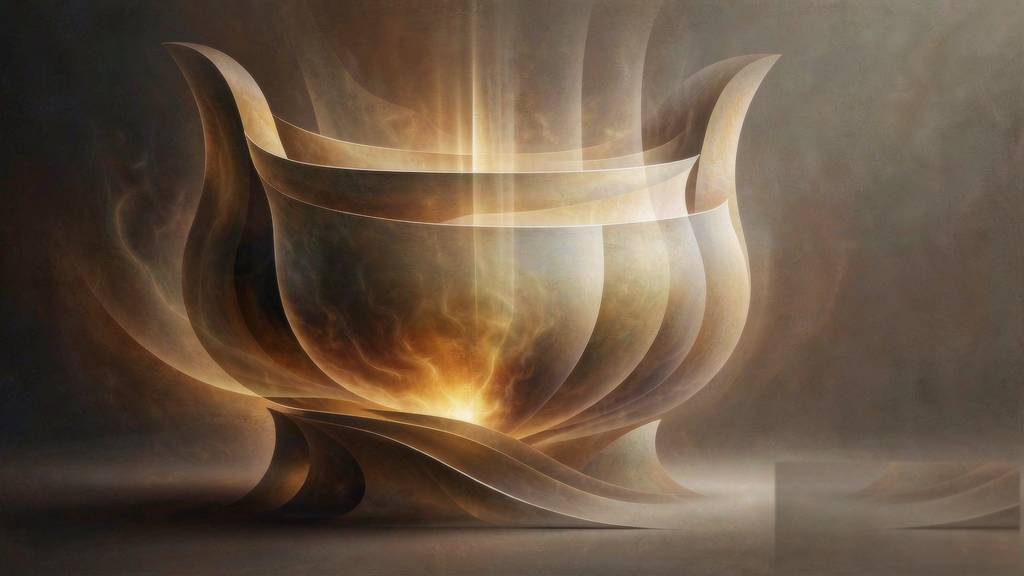
The vessel made newThe Cauldron
Simmer scattered fragments into one shape.
Ding is the ancient cauldron — wood below, fire above, cooking within. Its becoming a vessel: scattered things slowly fused by heat, time, and recipe. Ding is also politics — the bronze ding stood for state power. Its reminder: be a ding yourself — able to hold different ingredients, able to keep one thing simmering steadily for a long time.
First a line: the ding upside down — overturned to clear the dregs. To become a new vessel, consent first to being turned over. Then the warning: the ding's foot breaks — the base fails and the whole pot spills. Capacity and load-bearing have always been one thing.
Detailed reading
Hexagram 50 is fire fed by wind under a bronze vessel: raw material being turned into something that nourishes.
One image carries it: a cauldron over a fire with the wind keeping the flame steady.
What it gives is transformation — the capacity to convert what you have into what is genuinely useful. That is the half of the hexagram most people miss on a first reading.
The two trigrams
Hexagram 50, The Cauldron, is built from two trigrams: Wind below, which describes the inner situation you are standing in, and Fire above, which describes what the situation presents to the world. Wind below supplies the air while Fire above supplies the heat, so the vessel is only the meeting point of two forces.
Wind is yin beneath two yang lines: penetration rather than force. Its image is wood sending roots through soil, and air finding every gap. As a lower trigram it means gradual and largely invisible influence inside you; as an upper trigram it means the situation is being shaped by slow pressure rather than by one decision.
Fire is yin held between two yang lines: a bright core that still depends on something else to burn. Its image is flame, which needs fuel, gives light, and leaves nothing behind. As a lower trigram it means clarity and attachment inside you; as an upper trigram it means visibility — the situation will show what you are.
Read together, wind sets the tone inside you while fire shapes what actually meets you outside; the distance between those two is what this hexagram asks you to hold rather than to resolve.
Where it stands in the sequence
Hexagram 50 sits at position 50 of the sixty-four. It follows Hexagram 49 · Revolution and it is followed by Hexagram 51 · The Arousing. The sequence is not a list of separate ideas — each hexagram is the consequence of the one before it, which is why the book is read as a movement rather than as a dictionary.
It follows Revolution because overthrowing an order leaves the practical question of what feeds people now.
How to work with Hexagram 50
The specific warning attached to this hexagram is worth taking literally. Its failure mode is having the vessel ready with nothing in it, or the contents ready with nothing to cook them in.
What it asks of you instead is modest and concrete. Put the raw material into the container today and let the process run before judging the result.
What matters is that the action is real enough for somebody other than you to notice it.
Related hexagrams
Hexagram 50 has four natural neighbours inside the sixty-four: the two that stand next to it in the sequence, the one produced by reading its six lines in reverse, and the one produced by inverting every line. They are useful because they show the same situation from a different angle rather than describing a different situation.
- Lines reversed: Hexagram 49 · Revolution (革, Ge) — Fire below, Lake above.
- Every line inverted: Hexagram 03 · Difficulty at the Beginning (屯, Zhun) — Thunder below, Water above.
- Immediately after: Hexagram 51 · The Arousing (震, Zhen) — Thunder below, Thunder above.
- Its nuclear hexagram: Hexagram 43 · Breakthrough (夬, Guai) — Heaven below, Lake above.